
Our experts apply user-centred software development and usability analysis to ensure adoption of software in knowledge-intensive domains including Health. For further details click here
IPCEI CIS General Assembly & 8ra Open Conference – March 2026
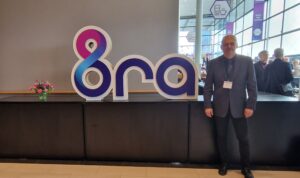
In the DS4 capacity as a partner of the ENACT project, our Managing Director Nikolay secured participation at the 8ra Annual Summit 2026 in Rotterdam and learned more about this funding initiative and potential interactions with Horizon Europe projects and other EU funding programmes.
IPCEI (Important Projects of Common European Interest), which is a new funding mechanisms in Europe, promotes strategic technologies, such as cloud-to-edge infrastructure, and drives EU economic growth. IPCEI-CIS (IPCEI on Cloud Infrastructure and Services) involves 12 Member States providing funds for Europe’s next generation cloud services.
Following Nikolay’s fruitful participation, DS4 and our project partners will explore further support that 8ra can provide to our ENACT project.
And as seen below, Nikolay happened to bump into a collaborator from about 20 years ago. Surprise opportunities always arise within this small world!
After 45 months work on the RoBétArmé project all partners got together one more time in the project final conference and presented their many achievements.
The construction industry stakeholders are all well aware of the challenges that the construction industry is facing including labour shortages, safety challenges, cost overruns and climate change. Our project addressed some of them through human-robot collaboration and advances in digitization, perception, mobility and shotcrete automation.
The final conference participants in the likes of construction and digitalisation industry experts and researchers had the opportunity to hear more about the project innovations, impact and outcomes through technical demonstrations and fruitful discussions sessions. Our DS4 team led the session on “The impact of Robots and AI in the Construction Industry”. Alongside our use cases partners from ARUP, Bouygues Construction and Christiansen & Essenbæk the discussion focused not so much on theory but what really works and what this means for jobs, productivity and project implementation.
Thank you Caelan, Christina, Mads, Bruno and Xavier for joining in our presenter Nikolay and showcasing your in-depth knowledge and professional expertise during our session. It’s been a pleasure collaborating with you 🙂
After exactly 42 months of carefully creating the Inspection Reconnaissance manipulator (IRR), the project partners gathered in the Alps to test it in real working conditions. The IRR is a complex system which consists of an autonomous rover and a laser welding robot/manipulator mounted on a trailer.
Our DS4 team, along with our partners from Bouygues Construction and the robot developers, watched intensely against the cold wind as the IRR rover was launched. Using its specially designed grippy tires, it rolled into the muddy tunnel. The rover confidently moved forward into the tunnel, scanning the environment with its camera and detecting defective rebars. The rebars are an essential framework to allow the spraying of shotcrete, ultimately allowing the building and repairing of crucial tunnel infrastructure.
We and the current end-users from Bouygues Construction, watched on amazed as an image of the rebars and surrounding environment appeared on the laptop. The 3D image highlighted the defects in the rebars. The rover then picked up the IRR manipulator (see pictures below) and towed it to the exact right spot. Sparks flew as the software instructed the manipulator to weld (fix) the defective metal rebars.
The end-users walked forwards tentatively towards the robot, minding their step. They examined the rebar carefully, tilting their head to see all angles. Then they looked back at us with a smile and nodding faces.
Our IRR robot, at its first ever real working environment testing, had performed an excellent repair.
As we interviewed the end-users afterwards, we enjoyed gathering valuable information for our evaluation analysis of this complex system. Next week we are eagerly waiting the testing of the Shotcrete and Finishing mobile manipulator (SFR); this is further addressing the unhealthy harmful conditions of the shotcreting process in harsh environment.
We would like to thank Bouygues Construction for their professionalism during the preparation and running of the tests. In addition to handling complex logistics and safety issues, they also took into consideration the project gender equality plan ensuring female partners felt comfortable during this thrilling experience.
To further immerse you into our human-robot collaborative work in the Alpine construction setting, we are providing the images below.